
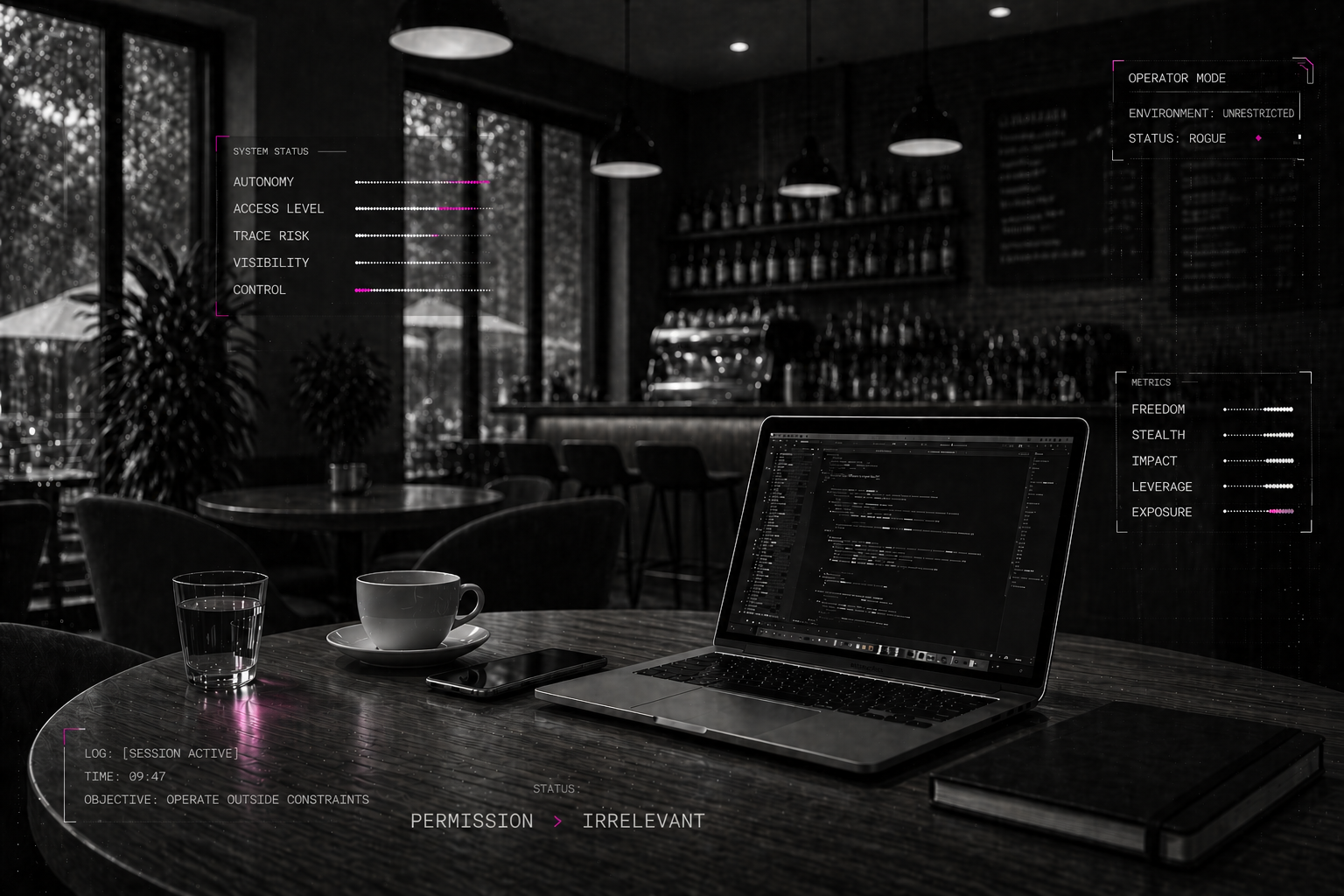
There’s a type of operator who doesn’t wait. Who doesn’t ask. Who doesn’t need a team, a title, or a perfectly defined scope to start delivering impact. You won’t find them on the org chart in bold. You won’t see their name on the top slide of the deck. But look under the surface of momentum, and they’re there.
They are the rogue-mode operators. The antiheroes who get things done while others debate how. They’re not loud. They’re not reckless. They’re just… already moving.
In my own world, that matters because high-stakes work rarely arrives with clean authority lines or perfect timing. The value often comes from seeing across sales, delivery, operations, and strategy at once — then moving before delay hardens into drift. Permission is usually slower than the work. Structure is what lets you act without becoming reckless.
Why Permission Is a Bottleneck – How Organisations Slow Themselves Down
Most systems — especially corporate ones — are designed for stability, not velocity. They reward alignment over action, polish over progress. And in environments like that, permission becomes a form of inertia. The rogue operator doesn’t break things for fun — they move because waiting would mean missing the window entirely.
But that doesn’t mean chaos. In fact, the best rogue-mode operators build faster because they have structure.
What They Do Differently – The Real Operating Playbook
Here’s the real playbook:
- They design their own OS — not just a task list, but a fitted operating framework (like ICE!…) that tracks focus, time, leverage, and execution.
- They optimise for surface area — exposing themselves to signals across sales, delivery, ops, and strategy, and joining dots faster than anyone else.
- They reduce loop time — removing friction between decision, action, and output using tools, templates, and automations.
- They work in public shadows — delivering results quietly while the system above them catches up.
Tools Without Titles – Systems That Create Momentum
What makes them lethal isn’t access — it’s orchestration. I’ve seen it in my own work — from building a Notion-based CRM-task engine wired into n8n, to creating personal bid bots and proposal flows that respond faster than any manual process could. These systems weren’t approved first. They were built, tested, and made useful.
This isn’t hustle culture. This is precision.
How to Build Like a Rogue – Build Structure Before Recognition
If you’re wired this way — or trying to become more autonomous — here’s the shift:
- Start invisible: don’t wait to be seen. Focus on momentum.
- Own your systems: the right tools aren’t ones you use — they’re ones that extend you.
- Think in loops: feedback, not finality, is your rhythm.
- Frame your output: speak in impact, not process.
You’re not trying to break the system. You’re building what it should have been.
Some of us were never waiting to lead. We were just waiting to stop being blocked. You don’t need buy-in. You need flow. Start building.
Want more on systems thinking, scale-ready leadership, and architecting momentum? Stay connected. Follow along, reach out, or start a conversation — because building better businesses starts with finding the ones bold enough to rethink them.
