
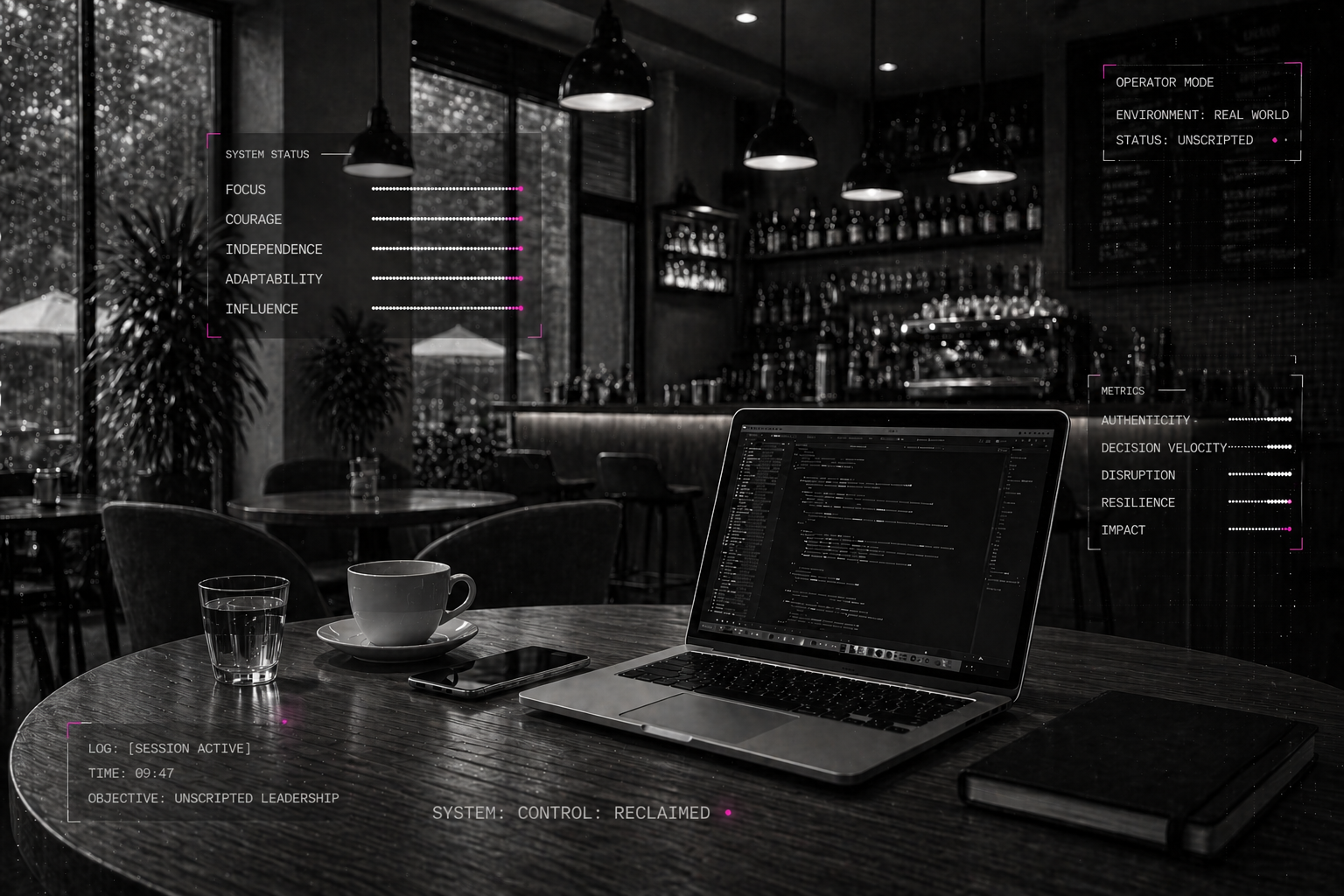
It was over ten years ago that I first wrote about the power of the antihero. I recently came across that piece again — and it stopped me in my tracks. Not because of what it said, but because I realised how unconsciously it had shaped me. Somewhere between then and now, it stopped being just an observation. It became a tenet — a through-line that explains how I work, how I lead, and how I see the people who truly move the needle.
The idea was simple: the ones making things happen weren’t always the loudest, cleanest, or most polished. They didn’t show up to win popularity contests. They weren’t poster children for leadership seminars. But they moved things. Quietly. Deliberately. With the kind of energy that didn’t need a job title to carry weight.
And here’s the thing: I still believe it. Maybe even more now.
What I’ve learned since is that real leadership rarely looks the way organisations describe it. In complex environments, the people who create momentum are often the ones operating without theatre, without much formal permission, and without any appetite for the script. They reduce noise, impose clarity, and move the work forward — even when the system around them is still busy admiring its own process.
We’ve Built a World of Chiefs – Why Real Leadership Gets Lost in Bureaucracy
Spend time in any organisation and you’ll see the same hierarchy play out:
- A constellation of chiefs, each with a growing stack of initials after their name.
- A loyal band of doers who keep the machine turning.
- And in between? Silence. Or worse: endless alignment meetings.
We use tired metaphors to describe the problem: “too many chiefs, not enough Indians.” It sounds clever, even self-aware. But it’s incomplete.
Because we forgot the third role:
The Shaman.
The one who doesn’t conform to structure, but defines culture. The one who doesn’t chase consensus, but creates clarity. The one who doesn’t wear the badge, but carries the fire.
You’ve met them. They show up differently. They listen harder, cut deeper, ask better questions. They bridge gaps, see patterns, and conjure the future into being—usually while everyone else is still stuck in last week’s backlog.
Antihero Energy in a Corporate Shell – Leadership in Complex Organisations
Now, I know what you’re thinking: “Sounds poetic, Gavin, but I work in a real business. With shareholders. And SLAs. And compliance teams.”
Same. I work in high-stakes environments too. Places where the cost of failure isn’t a missed KPI, but critical infrastructure downtime, operational chaos or lives fundamentally impacted.
And while structure is essential in those environments, it’s the antiheroes who often thrive in shaping and optimising it — solving the hard problems, designing the workflows no one else sees, and challenging what’s become calcified. But it’s not just critical systems — they thrive just as powerfully across operations, sales, and beyond — spotting patterns early, adapting instinctively to shifts, learning faster than most, and honing a distinct blend of capability, clarity, and controlled chaos. They don’t always follow the processes. They bend rules, sometimes break them. They create their own patterns—often messy, sometimes misunderstood. But in that chaos? There’s clarity.
Like Picasso said: “Every act of creation is first an act of destruction.”
These people dismantle what doesn’t serve. Not recklessly, but with purpose. They know that real progress often means unmaking the unnecessary, even if it offends the manual.
They’re not rude. But they are blunt.
They’re not rebellious. But they won’t nod along to nonsense.
They don’t need the credit. They want the thing to work.
They’re not playing your game anymore — they’ve already started designing the next one.
They’re not ignoring the playbook — they’ve just outgrown it.
And that’s the difference.
What Makes Them Different? – How Real Operators Create Clarity
Antiheroes make structure serve people—not the other way around. They:
- Hold conviction in the face of ambiguity.
- Protect focus from the noise of bureaucracy.
- Deliver clarity without needing a stage or slogan.
They might never wear a lanyard labelled “change-maker,” but you can trace the line of progress back to their fingerprints.
In my own work across sales architecture, emergency services, and systems design, I’ve seen it time and again: the most valuable people in the room are often the ones with no official permission to lead, but every ability to execute.
How to Find — and Leverage — Your Shaman
If you’re a leader worth your salt, you’ve already got one or two of them near you. They’re not always easy to spot. They don’t put themselves forward. They might irritate the system, or resist neat categorisation.
But if you want to find them, look for the ones who:
- Create clarity in chaos.
- Ask sharper questions than they answer.
- Don’t care about your hierarchy — but deeply care about the outcome.
- Quietly build the thing that ends up saving everyone else time.
And once you find them?
Don’t manage them. Don’t put them in a box. Give them space. Back them quietly. Trust that the chaos they cause is usually in service of something better.
Because if they’re a real shaman — an antihero in disguise — they’ll earn your trust not with performance, but with progress.
And Now?
We’ve seen what this looks like in the wild. Musk — erratic, relentless, allergic to bureaucracy — doesn’t just ship product, he rewires entire industries. Dorsey — minimalist, monk-like, more shaman than CEO — builds platforms, then walks away. And then there’s someone like Jason Fried. Calm, quietly defiant. Built Basecamp by rejecting hustle culture, VC pressure, and the growth-at-all-costs playbook. He doesn’t chase disruption — he redefines what healthy, focused business looks like, one principle at a time.
None of them fit the traditional mould. None of them chase applause. All of them design systems that shift the ground beneath us.
In a time of AI, automation, hyperconnectivity, and algorithmic noise, we need fewer polished operators and more of the weird, principled ones who actually build things.
We need the shaman. The antihero. The misfit who maps chaos into coherence.
You might be one. Or you might be quietly building next to one.
Don’t lock your antihero away. Harness the value in their chaos — or watch someone else build something better with it.
Ten years ago, I noticed the antihero from a distance. Now, I understand them from the inside — not as an idea, but as a pattern I’ve lived.
Want more on systems thinking, scale-ready leadership, and architecting momentum? Stay connected. Follow along, reach out, or start a conversation — because building better businesses starts with finding the ones bold enough to rethink them.
