
Let’s get something clear: I’m a terrible example to follow.
Over the years, I’ve built a personal operating system — a kind of modular life OS — that lets me move fast, think clearly, and deliver under pressure. In the last five years, I’ve closed multiple hundreds of millions in major IT programmes — not just selling them, but architecting core components and collaborating across every phase of the sales and operational lifecycle. The pipeline sitting beyond that is now larger again — maybe luck, maybe a snowball effect, more likely the compound return of building systems that let me keep adding value across disciplines without losing the thread.
It looks structured now, but it started as necessity: raw constraint, hard choices, and years of pressure testing.
Not because I got lucky.
Not because I followed a blueprint.
But because I learned to flex. To bend process, time, and pressure until something clicked. Something mine.
My personal operating system wasn’t downloaded from a course.
It was engineered through chaos, collisions, and relentless iteration.
It wasn’t clean. It wasn’t pretty.
It was survival, clarity, leverage — and then structure.
That doesn’t make it replicable.
It makes it dangerous to blindly copy.
What works for me works because it is fitted — to my constraints, my pressure patterns, and the way I move between commercial, operational, and technical conversations to add value.
Most Templates Will Fail You
We live in an age of guru worship.
Copy this. Swipe that. Run my playbook and unlock your freedom.
It’s seductive — and broken.
Because if you copy someone else’s system without understanding your own constraints, skills, energy patterns, and purpose, all you’re building is delayed failure in disguise.
And that includes mine.
Why Flex Matters More Than Efficiency
If you want to do something exceptional — to bend reality or move faster than the rules allow — you need access to flex.
Not just personal willpower, but room to move across your own life and your organisation.
As Tom DeMarco writes in Slack: Getting Past Burnout, Busywork, and the Myth of Total Efficiency, flexibility — not maximum efficiency — is what creates adaptability, creativity, and resilience.
There are three types of flex:
- Time Flex – Breathing room in your schedule to pause, pivot, or reflect.
- Money Flex – Capital to experiment, invest, or weather instability.
- Process Flex – Permission to break patterns, rewrite rules, and build differently.
You don’t need all three.
But without any of them, you stall. You default to copycat behaviour, because you can’t afford to do it your way.
That’s how echo chambers are born — and how sharp thinkers become stale replicators.
My flex has always been process.
I couldn’t always buy time. I didn’t always have capital.
But I could adapt faster, solve sideways, and make magic out of mess.
So that’s what I did.
The Game You’re Actually In
If you’re reading this, you’re probably the kind of person who:
- Can’t sit through pointless meetings
- Thinks faster than you can type
- Notices the flaw and the fix at the same time
You’re not looking for a playbook.
You’re trying to build a system that can actually carry your weight.
But that design has to come from you.
Why Your Personal Operating System Has to Fit You
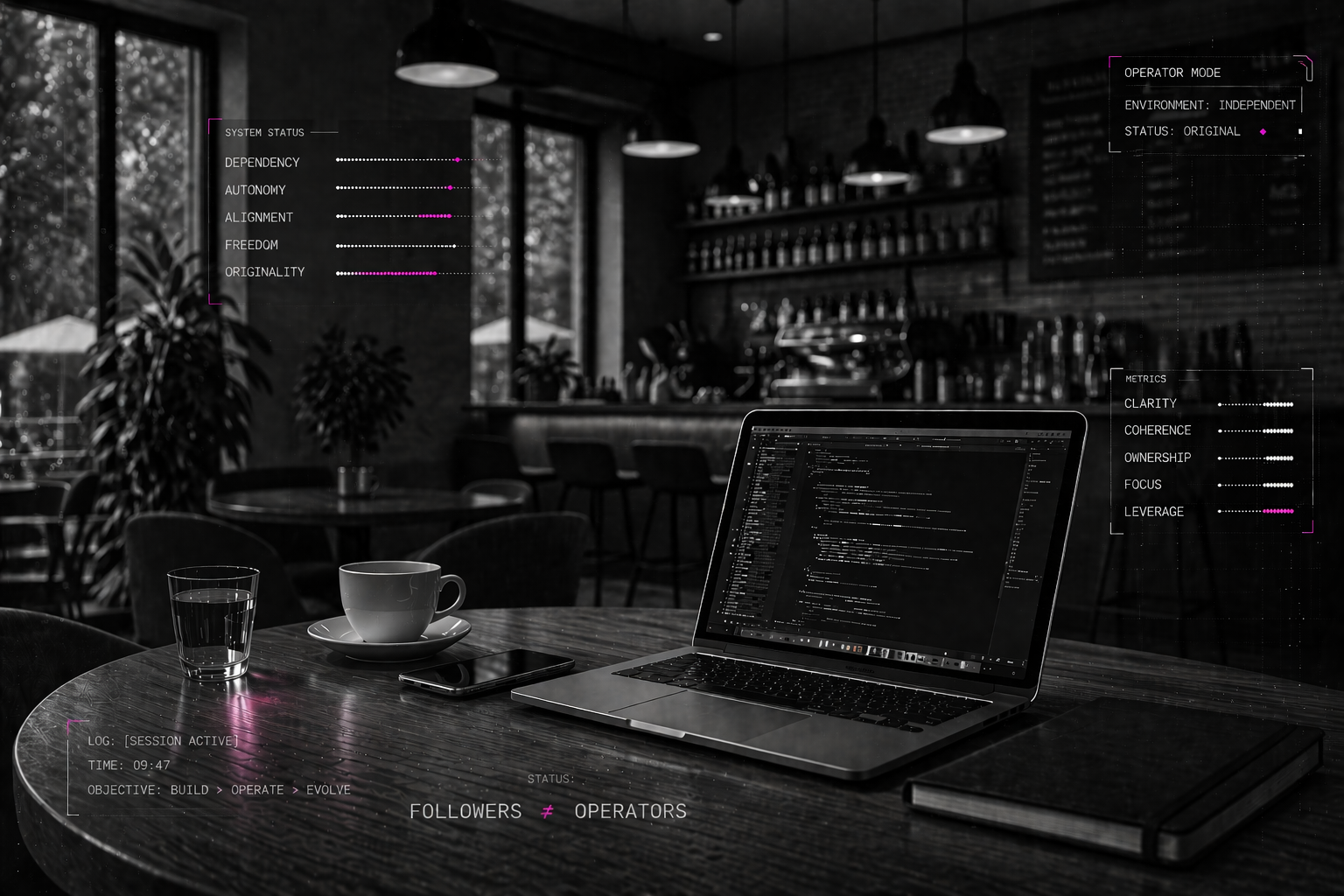
My personal OS is modular. It’s dynamic. It routes inputs, tracks intent, and turns ambiguity into action.
It’s part mental model, part execution engine — designed to fit my flow, not follow a formula.
But here’s the truth:
A system is only as powerful as its fit to its operator.
So your system needs to fit you — not me.
Build it from your own constraints, energy rhythms, strengths, and gaps.
Use AI to extend you, not replace you.
And don’t expect anyone else’s architecture to withstand the weight of your ambition.
Most Systems Serve Meetings, Not Momentum
According to McKinsey (2023), knowledge workers spend up to 61% of their time coordinating rather than executing. That is a useful signal that most systems still serve meetings, handoffs, and organisational drag more than momentum.
The fix is not another template. It is a system that routes around bloat and points you toward outcomes — fast.
Final Word
You don’t need a better system. You need your system.
And if you’re lucky — or deliberate — it might look nothing like mine.
Start building.
Stay sharp.
And don’t follow me.
Because I’m not your blueprint.
I’m just proof it’s possible.
Want more on systems thinking, scale-ready leadership, and architecting momentum? Stay connected. Follow along, reach out, or start a conversation — because building better businesses starts with finding the ones bold enough to rethink them.
