
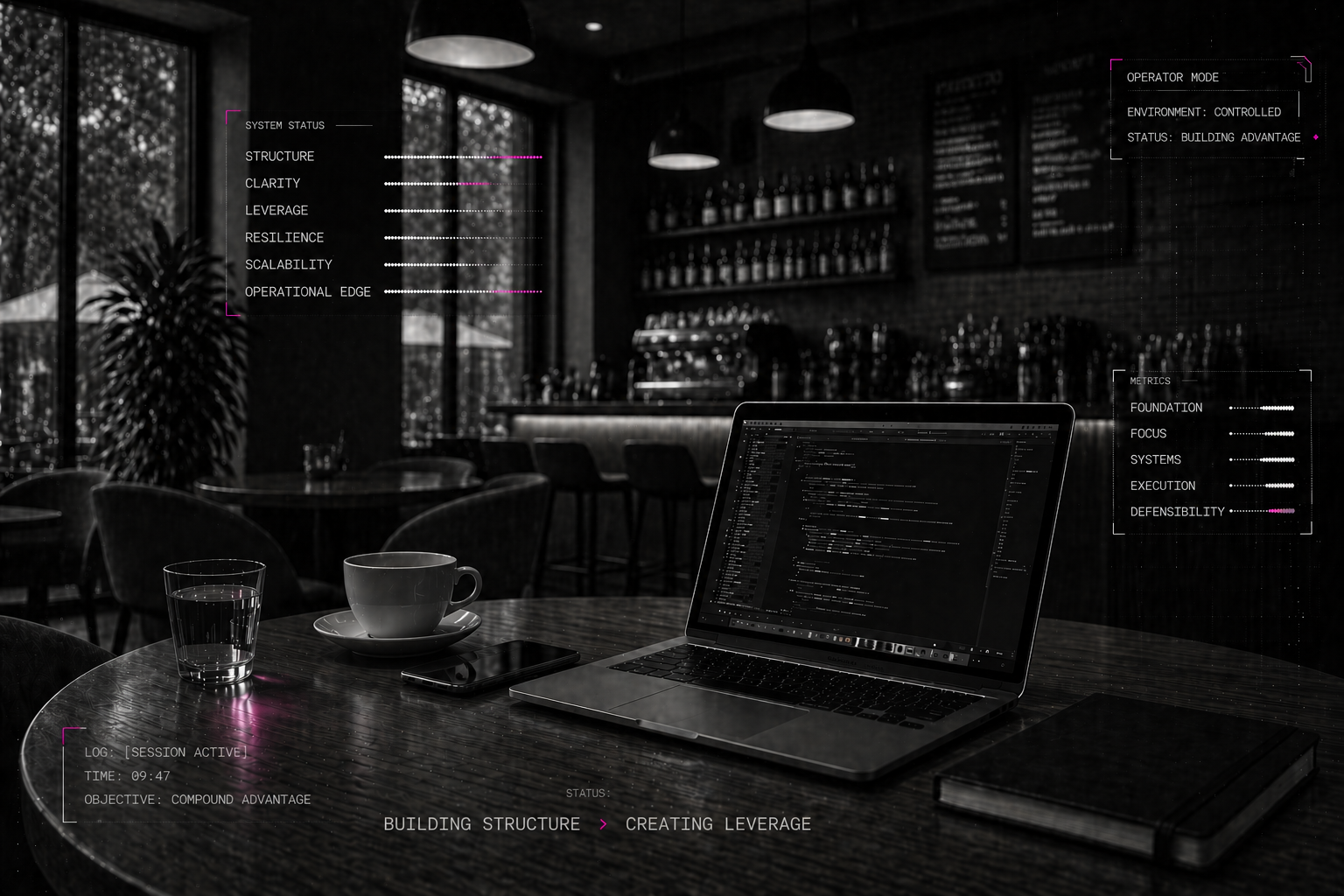
For most people, structure is something you install after things take off. You grow, then you organise. You get traction, then you systemise. But for rogue-mode operators — the ones who move fast, work alone, and think like architects — structure isn’t what follows momentum.
It’s what creates it.
In a world where noise scales faster than output, structure becomes a form of leverage. Not a constraint — a weapon.
In my own world, that matters because complexity arrives long before scale does. High-stakes work, multiple live threads, fragmented inputs, proposals, decisions, follow-ups — the bottleneck is rarely ambition. It is coordination, memory, and the drag created by carrying too much in your head. Structure is what lets one operator hold more weight without becoming the failure point. It also creates the space to bring other disciplines into the conversation — commercial, operational, technical, strategic — and add value in places a narrower operator would miss.
The Myth of “I’ll Sort It Later” – Why Structure Must Come Before Scale
Too many solo operators and early-stage teams run on instinct. Raw effort, deep talent, and a sea of open tabs. That works until it doesn’t. Until you forget which version is final. Until a client email gets missed. Until your brain becomes the bottleneck.
The antihero doesn’t wait for that moment. They build for it in advance.
Rogue-Mode Structure Isn’t Corporate – What Real Operational Structure Looks Like
Forget org charts, templates-for-templates, and 9-tab project trackers. The kind of structure that creates velocity is:
- Modular — built in blocks that can be rearranged, duplicated, or killed instantly.
- Looped — designed around feedback, not finality.
- Human-aligned — structured for how you think, not how some training manual says you should.
- Quietly powerful — visible to you, invisible to everyone else.
This isn’t operations theatre. This is tactical clarity.
What the Real Stack Looks Like – A Personal Operating System for Solo Operators
If you’re running solo, leading lean, or building in stealth — your edge isn’t more tools. It’s the right flow.
Here’s the minimum viable structure for a solo execution system:
- Your Personal OS — a system to track leverage, focus, and execution across time horizons.
- Task-to-action loop — nothing floats. Every task routes to execution or gets removed.
- Pattern filter — space to capture insight, spot repetition, and adjust systems.
- Delegation map — if it happens twice, it gets automated, documented, or outsourced.
I run mine through my own personal OS — ICE!… — built to turn thought into action without delay. It’s how I execute across projects, proposals, and systems without a team — and without letting anything drop.
Build It Before the Bottleneck
You don’t wait to structure once the chaos hits. You build structure to prevent chaos from ever owning your calendar.
You don’t need to scale yet. You don’t need a team yet. You need:
- Repeatable moves.
- A clean signal path.
- A sharp feedback loop.
Structure is how the rogue operator becomes the multiplier — without becoming the bottleneck.
- Thinking about scaling? Start with your system. Because the next gain won’t come from working harder — it’ll come from designing better.
The best structure doesn’t announce itself. It just removes friction, reduces decisions, and unlocks a pace others can’t explain.
Want more on systems thinking, scale-ready leadership, and architecting momentum? Stay connected. Follow along, reach out, or start a conversation — because building better businesses starts with finding the ones bold enough to rethink them.
